
 >
>Interview with Taylor R. Marshall about Sword and Serpent Trilogy
How did you first begin writing Sword and Serpent?
Taylor Marshall: It started in 2006 or 2007 as bedtime stories told to my oldest son, Gabriel. He loved knights, and I told him stories about Saint George and the dragon, and I invented extended journeys. I had mentioned it once to a Catholic priest, and he perked up and said, “That sounds fun. You should write them down.” I stayed up after the kids were in bed, sipped Grand Marnier, and wrote a novel.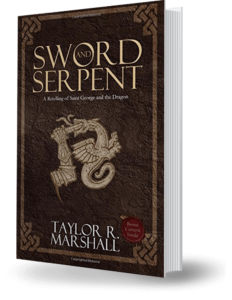
I sent off the original version in 2007 to several literary agents, perhaps ten or so, and all the responses were declines. I put it away and largely forgot it. After extensive revisions, it was published seven years later in 2014.
Who are your literary influences?
The original storyline derives directly from the story about Saint George in the Golden Legend by 13th-century Archbishop of Genoa Jacobus de Voragine. As a Catholic, I wanted to add more historical saints to the bedtime stories, so Saint Christopher (Menas in the book) and Saint Nicholas enter the story.
J.R.R. Tolkien and C.S. Lewis are influences because The Hobbit and Narnia are also like bedtime stories for children. It’s like The Princess Bride, where a grandfather reads a fantastical book to his grandson.
How did you situate Saint George in the Roman Empire of that time?
It all happens just before the conversion of Constantine during the fierce persecution of Christians by the Emperor Diocletian. This opens the possibility of incorporating dozens of famous Christian saints and martyrs from this time period, from about AD 299-303. The saints in the Trilogy are like Easter eggs hidden throughout the three books. I was also able to retell Saint George as the mystical cause of Constantine’s conversion and the Roman Empire’s conversion to Christianity.
Who is Eva or Sabra? Is she historical?
She is from the legend of Saint George and the Dragon. Sabra is a traditional name attributed to her. I also gave her the incognito name “Eva” (Latin for Eve) since she is under the power of the dragon/serpent and George frees her. She is an Eve figure, and George is an Adam figure. The name George in Greek means gardener or farmer, which is Adam’s vocation.
Without giving up the ending of Book 1, is the dragon real?
Certainly, the dragon is real! He is a preternatural apparition of Satan, who knows the sins and failings of George. The fight is physical, but it is chiefly mental and spiritual. In the Trilogy, Satan is possessing and animating the Roman Empire, and George is the lowly servant who slowly turns the tide so that Christ slays Satan through George. This deed ripples toward the Emperor Constantine.
Which is your favorite book in the Trilogy?
Book 3, Storm of Fire and Blood, is certainly my favorite and the best book in the series. It is the grand finale, and the last chapters are beautiful and still make me cry. This ending is truly George’s victory over death and Satan.
The Sword and Serpent Trilogy seems to set up the story of King Arthur and the Sword in the Stone. Do you intend to pursue an Arthurian sequel?
Readers know that Merlin appears in the Trilogy, and the ending does set up the Arthurian legend. I’ve drafted an outline for a King Arthur continuation, but I haven’t written anything.





What to Watch Next
SHOP THE TAYLOR MARSHALL STORE


Dive Deeper

GET CONFIDENT IN YOUR FAITH
Explore the fascinating world of Catholic teachings with Dr. Marshall. Together you’ll unpack the brilliant answers the Church gives to tough questions about the Faith. The best part: you go at your own pace. Start this exciting journey today.